
leadership
Navigating Leadership in the Not-for-profit Sector - Balancing Virtue and Compliance
Published: January 15, 2026
Read Time: 6 minutes

Working in the not-for-profit sector presents unique challenges. These organisations, dedicated to societal impact, must adhere to strict regulations, from securing grants to maintaining charity status for tax-deductible donations. For leaders, the challenge goes beyond compliance—it’s about ensuring that decisions align with the organisation’s core values of virtue, ethics, and social responsibility while navigating complex rules and frameworks.
The central question faced by many leaders in the not-for-profit sector is this: How can we remain value-based, virtuous, and ethical while working within these constraints? More importantly, how can we meet the demands of leading an organisation without feeling stifled by the very rules and policies that ensure compliance and maintain organisational recognition?
The not-for-profit sector is driven by a mission to serve the greater good, yet leaders must navigate complex compliance frameworks. While these rules ensure transparency and accountability, they can feel restrictive. How can leaders remain true to their ethical ideals without compromising organisational goals, and avoid being trapped by rigid policies?
One solution is to reframe leadership within the sector, viewing compliance not as a limitation but as a foundation for trust, transparency, and sustainability. This shift allows for creativity in aligning practices with core values. However, it requires leaders to continuously reflect, remain committed to ethical decision-making, and adapt policies without compromising the organisation’s integrity or mission.
Impact of Social Identity and Subject Position on Decision-making
Aligning organisational practices with core values requires understanding how an individual’s identity and position influence decision-making. While decisions may seem objective, they are often shaped by personal values, beliefs, culture, and experiences. These subjective factors play a crucial role in how leaders evaluate options and make choices, impacting the decision-making process.
Leadership decisions are inherently complex, shaped by both personal and situational factors. People belong to various social groups—sporting teams, social circles, or professional organisations—that influence behaviour and perceptions, dictating how individuals think and act. Our subjective understanding of situations is influenced by social identity, which guides decision-making. Additionally, the process of identity formation impacts our moral identity, shaping how we perceive our actions within societal norms and expectations.
Our moral identity, in turn, is shaped by how we believe others will perceive our behaviour. This highlights the complexities involved in ethical decision-making. Leaders must be aware of their social identity and the inherent biases that come with it. Moreover, understanding how their position within the organisation and society impacts their decisions is crucial for making informed, ethical choices that align with organisational values.
Ethical Conation and Decision-making
Leaders who wish to consistently embody virtue must develop the capacity for ethical conation. Conation encompasses cognitive, emotional, and physical capacities—how we think, feel, and act. It involves the habits of mind and body developed through deliberate practice, ranging from daily rituals to how we respond to challenging situations.
An often overlooked aspect of ethical conation is moral temptation, where individuals face internal value conflicts despite knowing what is right. In these situations, self-regulation is crucial. Leaders must prioritise moral actions over personal values or external pressures, ensuring ethical integrity, especially when making difficult decisions that challenge their values.
Virtuous impulses, through consistent practice, can become ingrained so deeply that they feel like instinctive responses, especially in high-pressure scenarios where immediate decisions are required. However, stress, ambition, and external pressures can impair judgment and lead to risky ethical decision-making. This makes it essential for leaders to engage in regular self-reflection and consciously practice values-based leadership.
A leader’s ethical impulses are shaped by both their knowledge of ethics and their social identities. These influences can either hinder or enhance virtuous behaviour. By consistently practicing values-based leadership, leaders can integrate these virtues into their habits, ensuring they act in alignment with their values, even in challenging circumstances.
Building Virtuous Leadership
Effective leadership in any organisation, including the not-for-profit sector, involves wrestling with three key elements outlined in the Virtuous Leaders Framework:
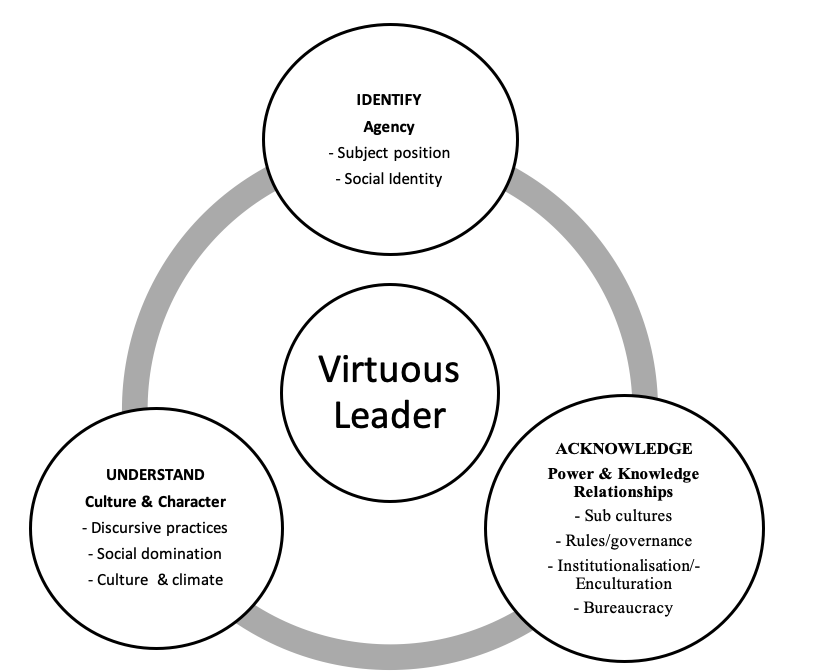
The ‘Virtuous Leader’s Framework’ breaks down these complexities of leadership decision-making into three essential components. This framework provides clarity and guidance for leaders navigating the everyday challenges of decision-making in the not-for-profit space.
-
Identify: Agency through Subject Positions - Leaders need to understand their social identity and subject positions to gain insight into how these factors shape their decision-making.
-
Understand: Culture and Character - Leaders must also understand how an organisation’s culture and discursive practices (such as rules, policies, and procedures) mould individual character. A culture that promotes integrity, transparency, and accountability will encourage similar values in its leadership.
-
Acknowledge: Power and Knowledge Relationships - To navigate ethical dilemmas and truly embody virtuous leadership, leaders must recognize the influence of power dynamics and institutional knowledge within their organisation.
Fostering a Culture Grounded in Virtues and Values
While highly rules-and compliance-driven organisations can pose challenges, there are ways for leaders to stay aligned with virtuous leadership principles. Below are strategies for creating a values-based culture and developing virtuous leadership within these constraints:
-
Refine Selection Processes: Leaders should focus on selecting individuals who uphold high ethical standards. This is especially important when choosing board members who will play a critical role in holding others accountable. Ensuring that individuals with a strong moral compass are in leadership positions will help maintain ethical standards across the organisation.
-
Trust and Integrity: Trust is the foundation of effective leadership. Senior leaders must foster an environment of trust by consistently demonstrating integrity in organisational culture and practices. When leaders act with integrity, they set a powerful example for others to follow.
-
Balancing Rules and Ethical Flexibility: Leaders often face the challenge of balancing strict compliance with the flexibility needed for ethical decision-making. Finding this balance is crucial for leaders who want to pursue ethical excellence without compromising operational goals.
-
Acknowledge Diverse Experiences: Leaders should recognise the diverse backgrounds and subject positions of their team members. By integrating virtues-based leadership into daily practices, leaders can encourage character development and practical wisdom, ultimately shaping the organisational culture.
-
Clarify Dynamics of Power and Position: It is important to understand the dynamics of title, rank, and position within an organisation. Empowering individuals at all levels to make virtue-based decisions without fear of reprisal will encourage ethical behaviour across the board.
-
Embrace Character Development: Virtue and character development should be incorporated alongside leadership training. Organisations that focus on building character can foster a culture that values ethics and integrity, ensuring that virtuous leadership is sustained.
-
Shape Organisational Habitus: The collective experiences and shared identity of an organisation shape its habitus, or the way individuals behave. By embedding virtues in leadership development, organisations can shape the habitus of their members toward virtuous behaviour, encouraging ethical practices across all levels.
Conclusion
Navigating the challenges of maintaining ethical leadership in the not-for-profit sector while adhering to compliance frameworks is no easy feat. However, it is not a matter of choosing between virtue and compliance. Instead, effective leadership involves integrating both into a coherent framework where values guide decision-making and compliance supports the organisation’s long-term sustainability. By doing so, leaders can ensure that their organisations not only survive within the rules but thrive ethically, creating a meaningful impact on society while remaining true to their values.
This article is adapted from Kate Robinson’s research and book: ‘Values, Moral Courage, and Bureaucracy: Navigating the Journey to Virtuous Leadership in Rules-based Organisations’.
This article was first published in this form in the 2025 Better Boards Conference Magazine.
Further Resources
What Are Your Leadership Anchors?
Finding Collective Leadership Success
Ethical Leadership at Board Level – What does good look like?
Share this Article
Recommended Reading
Recommended Viewing


Author


-
Vice Chair
Women Veterans Australia
- About
-
Dr Kate Robinson is the founder and Director of CommuniKate Consulting and a Women Veterans Australia Board Member. She holds a Bachelor of Business, Master of Business Administration, Master of Applied Social Research, a Graduate Certificate of Professional Writing, and is a Doctor of Philosophy. Her career has spanned leadership, consulting and advisory roles and though specialised in change management and communication has shifted her expertise to turning complex research into meaningful and tangible insights with practical application.
Kate is passionate about ethical and moral leadership and behaviours underpinned by a positive virtuous culture. Kate has worked both nationally and internationally (Australia and the US) for top ASX-listed companies and notable not-for-profit national organisations at senior levels. She is an accomplished professional with extensive experience with C-level executives and an ability to communicate across all levels within an organisation.
In completing her PhD, Kate explored how ethical and values-based leadership increasingly challenges leaders in rules-based organisations, focused on industries such as Defence and other highly codified organisations. Kate’s research has appeared in leading journals such as the Journal of Business Ethics and she has presented at notable international conferences (ICBEML - Paris and AOM - Boston). Her research has been developed into a seminar education and training video for the Australian Defence Force. Kate’s book has been internationally published based on her research.


Found this article useful or informative?
Join 5,000+ not-for-profit & for-purpose directors receiving the latest insights on governance and leadership.
Receive a free e-book on improving your board decisions when you subscribe.
Unsubscribe anytime. We care about your privacy - read our Privacy Policy .