
glossary
What Is Sociocracy? Consent-Based Governance for Organisations
Governance GlossaryPublished: December 6, 2023 Last Reviewed: March 6, 2026

Key Takeaways
- Sociocracy is a governance model based on consent rather than majority voting.
- Decisions are made in circles — semi-autonomous teams with authority over their domain.
- The three core principles are consent, circles, and the double link between circles.
- The board of directors remains the top circle with ultimate authority.
- Sociocracy works well in organisations with clear policies and experienced staff.
Sociocracy is an organisational structure where decisions are made by consent rather than by majority vote or top-down authority. Instead of one person or committee calling the shots, small teams (called circles) each govern their own domain.
Sociocracyforall.org defines it as a ‘peer governance system based on consent’. In practice, this means staff participate directly in the decisions that affect their work. Each circle has its own purpose and authority, so feedback does not have to travel up and down a chain of command before anything changes.
The main benefit for governance is that no one gets ignored. Decisions take longer to make, but they stick — because the people carrying them out had a say. Organisations that use sociocracy also tend to see better delegation and more willingness to cooperate across teams.
Sociocracy principles
Sociocracy rests on three principles.
Consent. A decision is approved when no one in the group raises a reasoned objection. This is different from consensus (where everyone must agree) and from majority voting (where 51% wins). A member does not need to love the proposal — they only need to confirm it will not prevent the circle from doing its work.
Circles. Governance is organised in circles rather than a top-down chain. Each circle is semi-autonomous, self-organising, and responsible for a specific domain. The board does not micromanage; each circle governs its own area.
The double link. Each circle is connected to the one above it by two people: a leader appointed by the parent circle (top-down) and a delegate elected by the sub-circle (bottom-up). Both sit as full members with consent rights in each other’s meetings. This two-way link prevents any single person from controlling the flow of information between levels. When someone objects to a proposal, the circle works through the objection until a version passes that no one blocks.
Board members retain authority over strategic direction and financial oversight. As the top circle, the board makes its own decisions by consent — a proposal passes when no director raises a reasoned objection, which is a qualitatively different standard from majority voting.
Sociocracy governance structure
Sociocracy was developed by Dutch engineer Gerard Endenburg in the 1970s, building on the educational philosophy of Kees Boeke. Endenburg formalised the approach as the Sociocratic Circle-Organization Method (SCM) and applied it to his family’s electrical engineering company. The model has since spread to not-for-profit organisations, cooperatives, and community groups. A more modular variant, Sociocracy 3.0 (S3), blends sociocratic consent with agile and lean thinking.
The structure is flexible — organisations adapt it to fit their size and needs. Each circle has four elected roles: a leader (coordinates operations), a delegate (represents the circle in the parent circle), a facilitator (runs meetings), and a secretary (records decisions).
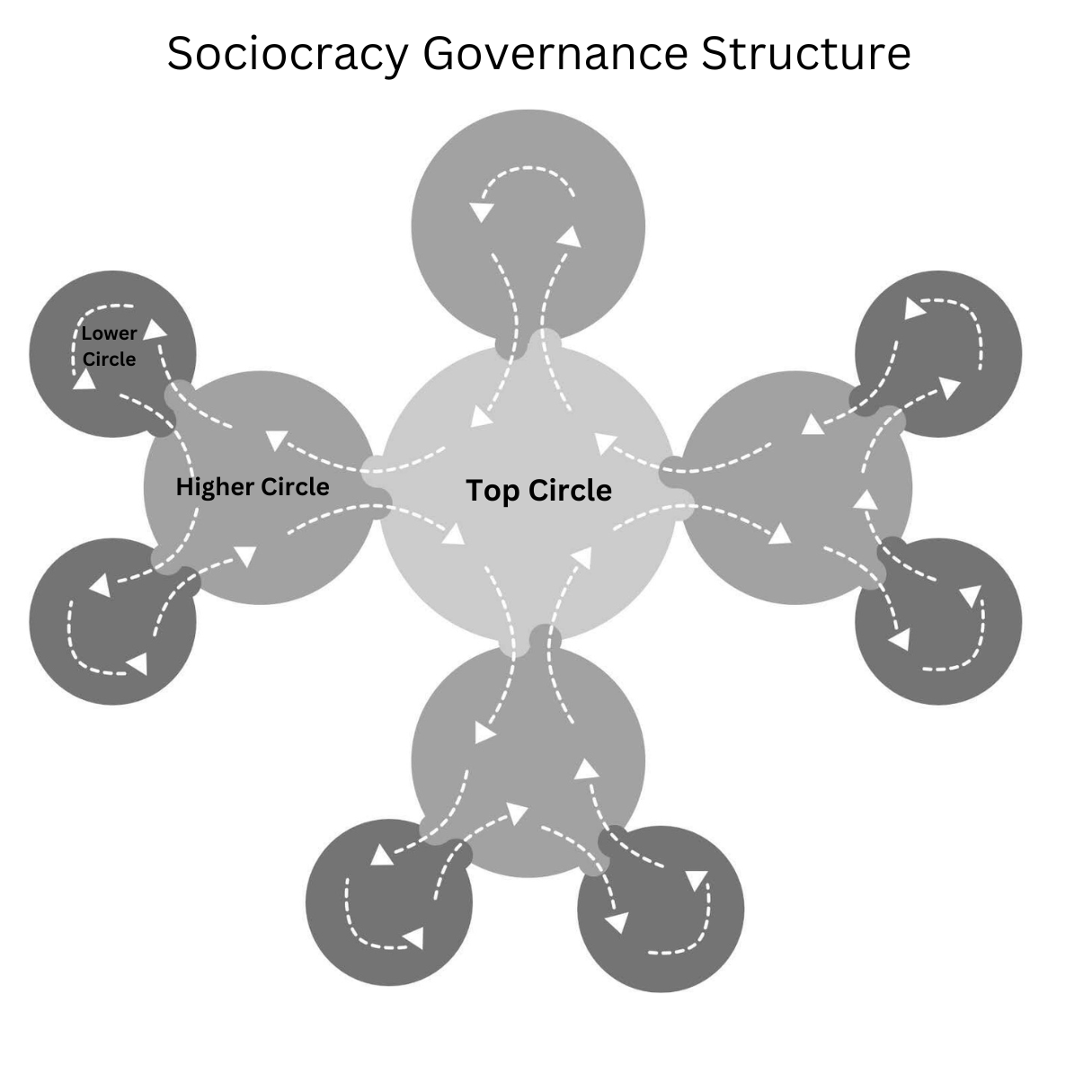
One person can hold several roles within their circle. Each circle makes decisions about its own domain without needing permission from the top. They do, however, need to coordinate with other circles when their goals overlap.
The Board of Directors sits at the top of the circle hierarchy. Below it, the general circle (sometimes called the mission circle) coordinates operations across sub-circles. Delegates and leaders are the connective tissue — they attend each other’s meetings to keep information flowing between levels. Some organisations add a coordinating circle made up of representatives from each team. Others use a general circle that handles cross-cutting operational support.
Applying sociocratic principles at the board level
Not-for-profit boards that want to adopt sociocratic principles do not need to restructure the entire organisation at once. A practical starting point is to introduce consent-based decision-making at board meetings. Rather than calling for a majority vote on each motion, the chairperson can present a proposal and ask whether any director has a reasoned objection. If no objections are raised, the proposal is approved. If an objection is raised, the board works through the concern until a version of the proposal is found that no director objects to. This shifts the focus from winning votes to finding workable outcomes.
Boards can also apply the circle principle by giving committees genuine authority over their domains. Instead of requiring every committee recommendation to be ratified by the full board, the board can define a clear scope within which each committee makes its own decisions and reports back through a double-link representative. This frees up board meeting time for strategic discussion and gives committee members a stronger sense of ownership. The double-link structure, where both the committee chair and a board-appointed representative attend each other’s meetings, keeps information flowing in both directions without adding unnecessary reporting layers.
Some Australian housing cooperatives and community-managed organisations already operate with consent-based decision-making structures that closely resemble sociocracy. Boards considering a shift to this model can trial it within a single committee before rolling it out more broadly.
Boards considering sociocracy should document these processes in their bylaws or governance policies so that the approach is understood by incoming directors and survives leadership transitions.
Frequently Asked Questions
What is the main sociocracy criticism?
An organisation with a structure based on sociocracy must make decisions by consent. This means problem solving is done collaboratively and everyone can share their opinion. In comparison, a traditional hierarchy has clear boundaries between the top and other levels when it comes to authority and reporting. Sociocracy leadership works well in organisations that have clear policies about how decisions are made about how work is done.
However, new organisations may need to do more work to define their workflows, systems, and collaborative processes such as training staff on how to make decisions by consent. When circle members understand the operations side of the work and have expertise and experience in their domain, sociocracy can be an effective governance structure. However, circle priorities may conflict with the rules, principles, or methods of other circles, creating the challenge of having to negotiate decisions and planning for as long as it takes.
What is the difference between consent vs consensus?
Consensus decision making is the process of reaching an agreement by working together to find a mutually acceptable solution. It involves agreeing as a group rather than voting and deciding based on what the majority wants. The intention is inclusiveness and accountability, but consensus involves more facilitation and flexibility, and a willingness to share control.
Consent decision-making is similar to consensus. All group members get to choose whether they agree with the decision or not. The process involves finding a balance between your preference and what you’re willing to tolerate. Consent-based decisions are meant to avoid creating a right/wrong dynamic in the group and can encourage common ground between people.
What are the rules and processes for making decisions?
Sociocratic leadership includes bylaws and consent-based decisions. Instead of needing a majority vote of 51% or more, decisions are made by discussing the issue or proposal. Circles must meet at least every three months for formal policy review, though operational meetings occur far more frequently. These sessions are part of the organisation’s strategy to evaluate effectiveness, review policies, and recommend changes.
Decisions are made during ‘rounds’, which consist of each person speaking one after the other to make sure everyone has been heard. Rounds are intended to create group cohesion and a more democratic approach to operating the organisation. Circle members are assigned their roles through consent rounds, and the secretary is responsible for record-keeping and maintaining a logbook. The circle objectives are determined by the higher circle.
For information on how to manage meetings and record decisions, visit Better Boards’ Our Cat Herder board portal.
Related terms
Further resources
Sociocracy For All — community and training resources for consent-based governance.
Our Cat Herder Board Portal — manage board meetings, decisions, and documentation.
Recommended Reading



Recommended Viewing



Author


- About
-
Better Boards connects the leaders of Australasian non-profit organisations to the knowledge and networks necessary to grow and develop their leadership skills and build a strong governance framework for their organisation.

Found this article useful or informative?
Join 5,000+ not-for-profit & for-purpose directors receiving the latest insights on governance and leadership.
Receive a free e-book on improving your board decisions when you subscribe.
Unsubscribe anytime. We care about your privacy - read our Privacy Policy .