
leadership
Leadership Team Essentials...Board, CEO and Executives
Published: August 15, 2026 Last Reviewed: August 17, 2026
Read Time: 5 minutes

Conceptually and practically, an equilateral triangle’s unique properties provides a board that operates (or is exploring the idea of operating) a leadership team with important information, insights and considerations.
In the world of engineering an equilateral triangle is considered the strongest structural shape; its unique properties include:
- an even distribution of weight, which allows for greater stability and heavy loads without collapsing,
- an even spread of force, where any additional force is evenly spread throughout the structure rather than concentrated on any one area,
- the transfer of an applied force, in a way that no other shape can withstand.
In the world of Not for Profits (NFPs) a leadership team can be considered the strongest organisational structure; its true value and benefits occur when:
- it brings together the directors who make up the positions of the board, the chief executive officer and all executive / management team members into one united, focused and disciplined team,
- each individual is mature enough to operate as part of a team, mindful that their respective positions, roles and responsibilities create an organisational leadership structure, rather than just stand alone leadership positions,
- the primary intellectual capital of these individuals is brought together to establish a continuous collegial approach, an envisioned state and an agreed strategy, with the aim of delivering organisational success and sustainability.
Within all NFP industries and sectors there are an increasing number of organisations and associations that either operate or are exploring the idea of establishing a leadership team, alternatively known as the ’triangle of leadership or leadership triangle’, a model of which is represented below.
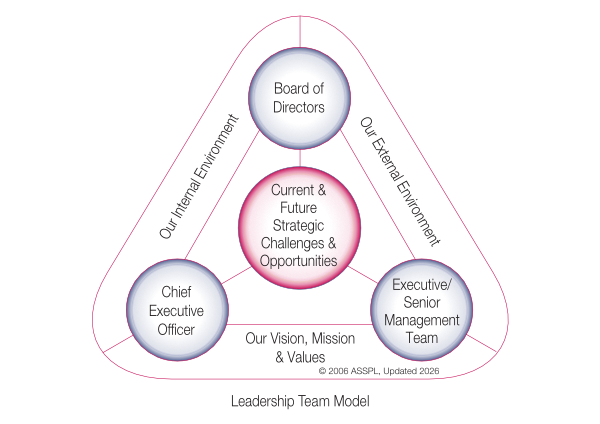
In essence this is just one type of organisational leadership model, wherein the modius operandi can be characterised by:
-
An Enduring Partnership: that not only recognises each leader’s different roles and responsibilities, but as a team the board governs the organisation, the CEO leads the organisation and executives / managers manage the operations, a partnership in the governance, leadership and management of the organisation.
-
Professional Relationships: that recognise and utilise individual leader’s personal and professional capabilities and experiences, knowledge and wisdom, contacts and networks and enhance individual and team professional working relationships.
Given, that as the number of team members increase, so do the number of relationships that have to be established and nurtured, eg: five individuals equals ten relationships, nine individuals equals thirty six relationships and so on.
-
A Board’s Authority Remains: in all board meetings and strategy workshops operated via a leadership team, the board, chief executive officer or executive / management team recognise the board’s authority and their power must remain.
Most importantly as a team, they ensure the board’s ultimate decision-making powers, on behalf of members - the owners of the organisation, must be enacted when required, given the directors are the custodians, guardians and stewards of the organisation.
-
The Measure of Maturity: all NFPs, whether small, medium, large or extra-large, can be categorised as either leading organisations, 5% - 10%, following organisations ( upper, middle or lower ), ranging from 70% - 80% or resisting organisations comprising the remaining 5% - 10%.
These three categories reflect an organisation’s governance, organisational and service maturity, in part the preparedness of the board to establish and operate a leadership team; with leading and upper following organisations typically operating or considering the establishment of a leadership team.
-
A Definitive Culture, A Defining Culture: a chairperson’s ability to lead and facilitate will not only enable a leadership team to traverse many strategic and organisational ideas and opportunities, challenges and risks, but most importantly continually test and strengthen the leadership team’s culture.
It is widely known that a culture founded on the continuous recognition and enactment of an organisation’s vision, mission and values assists in the establishment and maintenance of definitive and aligned individual, team and organisational attitudes, behaviours and work practices.
-
A Strategic Focus: when every team member can understand and address the internal and external drivers, forces and trends that bring about various strategic, organisational or service impacts and implications for their organisation, the leadership team’s strategic activities are suddenly recognised as being absolutely mission critical.
Substantial research clearly indicates that the combined intellectual capital of a leadership team far out-weighs that of a stand-alone, “do it on its own” board; that is one that operates a linear structure - board, CEO and executive / management team - rather than the equilateral triangle of leadership.
-
All Voices Are Heard: within every board meeting or strategy workshop, as all participants listen, learn and work with each other. They do not just rely on the dominant players and their opinions, the intensity of group dynamics or the power, politics and personalities of the day; given a leadership team may bring together 12-18 individuals.
Once again a chair’s ability comes into play - to clearly set meeting or workshop objectives, agendas and outcomes, engage every individual, restrict long winded speakers and summarise discussions before a motion and decision is made - all are vital leadership and facilitation skills and capabilities.
-
Moving From A Triangle to Diamond: with the ultimate goal being that once well established a leadership team has the opportunity to utilise open strategy and co-design principles and practices, especially within its annual or quarterly strategy workshops, therein engaging staff, volunteers and clients in new and innovative ways; in essence moving from a triangle to a diamond model of leadership.
If your board currently operates as a leadership team or is exploring the idea, both the three unique properties of the equilateral triangle, along with the characteristics of the leadership triangle, set the scene for your board’s deliberations on this matter; the benefits and value of such a model should not be under estimated.
Mindful of my 1991 quote, “excellent board, excellent CEO, excellent executive team, excellent leadership team, excellent organisation”.
Further Resources
Adaptive Governance… Transformational Leadership
Transformation Starts at the Top
Can Boardroom Leadership Meet the Challenges of the Future?
Integrated Leadership – Solving complex problems with the power of many
Preventing and De-escalating NFP Dysfunction: The Role of the Chair
Share this Article
Recommended Reading



Recommended Viewing



Author

-
Principal Consultant
Australian Strategic Services
- About
-
As Chairman of Better Boards and Managing Director of Australian Strategic Services, Michael Goldsworthy’s passion for community businesses (NFPs) cannot be underestimated. For thirty years he has advanced their cause, strengthened their governance and delivered pragmatic solutions; ensuring community businesses remain a vital part of Australian communities and the economy.


Found this article useful or informative?
Join 5,000+ not-for-profit & for-purpose directors receiving the latest insights on governance and leadership.
Receive a free e-book on improving your board decisions when you subscribe.
Unsubscribe anytime. We care about your privacy - read our Privacy Policy .